|Rome, 29 October 2025|
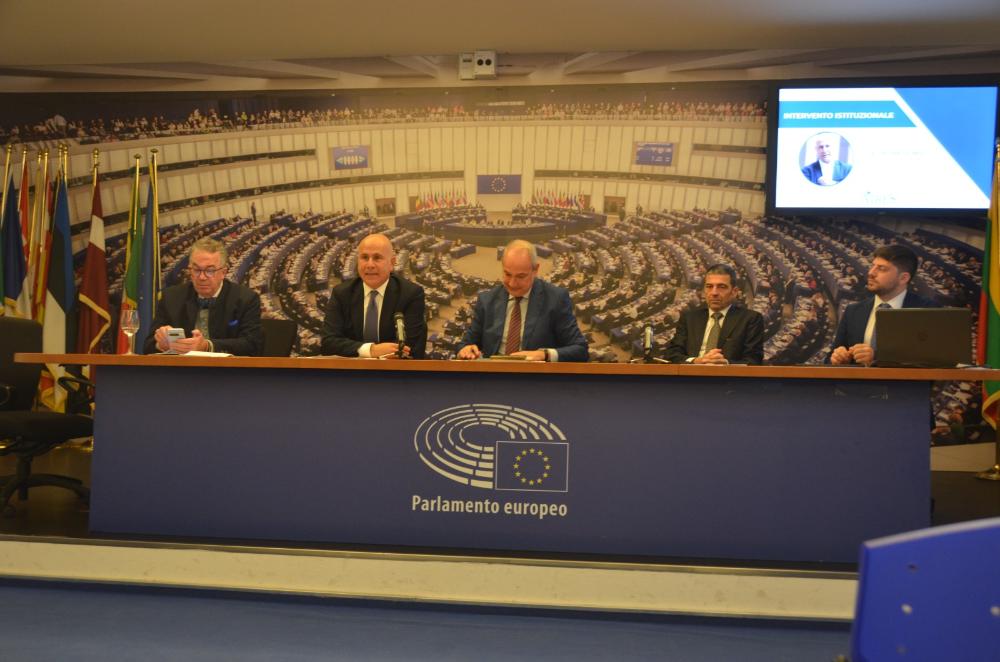
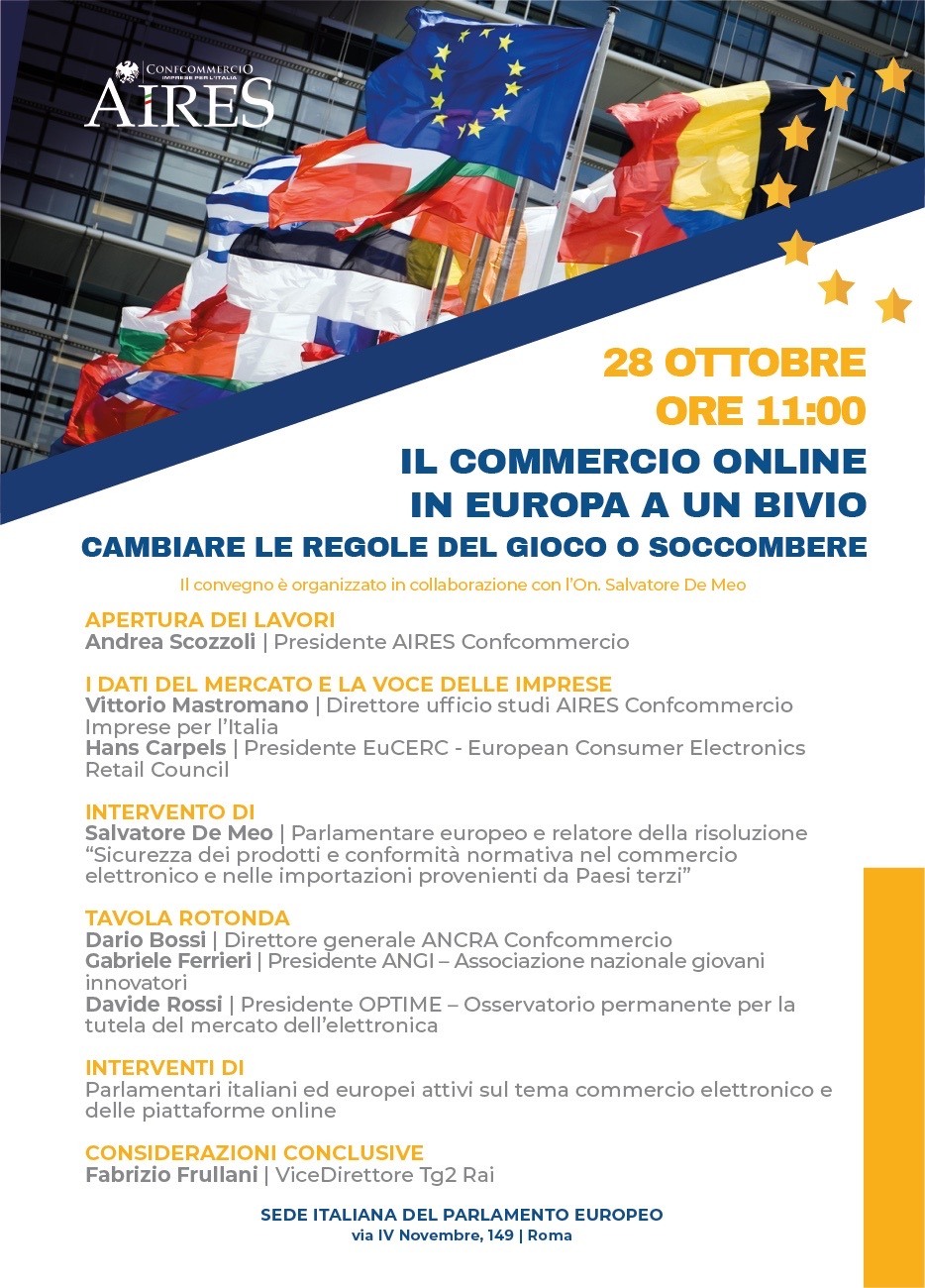
The need for stronger alignment between market dynamics and regulatory action was at the core of the conference “Online Commerce in Europe at a Crossroads: Change the Rules or Fall Behind”, organised in Rome by AIRES–Confcommercio in collaboration with Member of the European Parliament Salvatore De Meo.
Opening the event, AIRES President Andrea Scozzoli stressed the importance of collective action within the sector, alongside faster and more responsive policymaking at both national and European level. “E-commerce operators must strengthen their capacity to aggregate,” he noted, “while governments need to act more swiftly in translating market needs into effective legislation.”
The discussion brought together key stakeholders, including Maurizio Gasparri, President of Forza Italia Senators; Hans Carpels, President of the EuCER Council; Vittorio Mastromano, Head of Research at AIRES; Dario Bossi, Director General of ANCRA Confcommercio; Gabriele Ferrieri, President of ANGI; and Davide Rossi, President of OPTIME and Director General of AIRES.
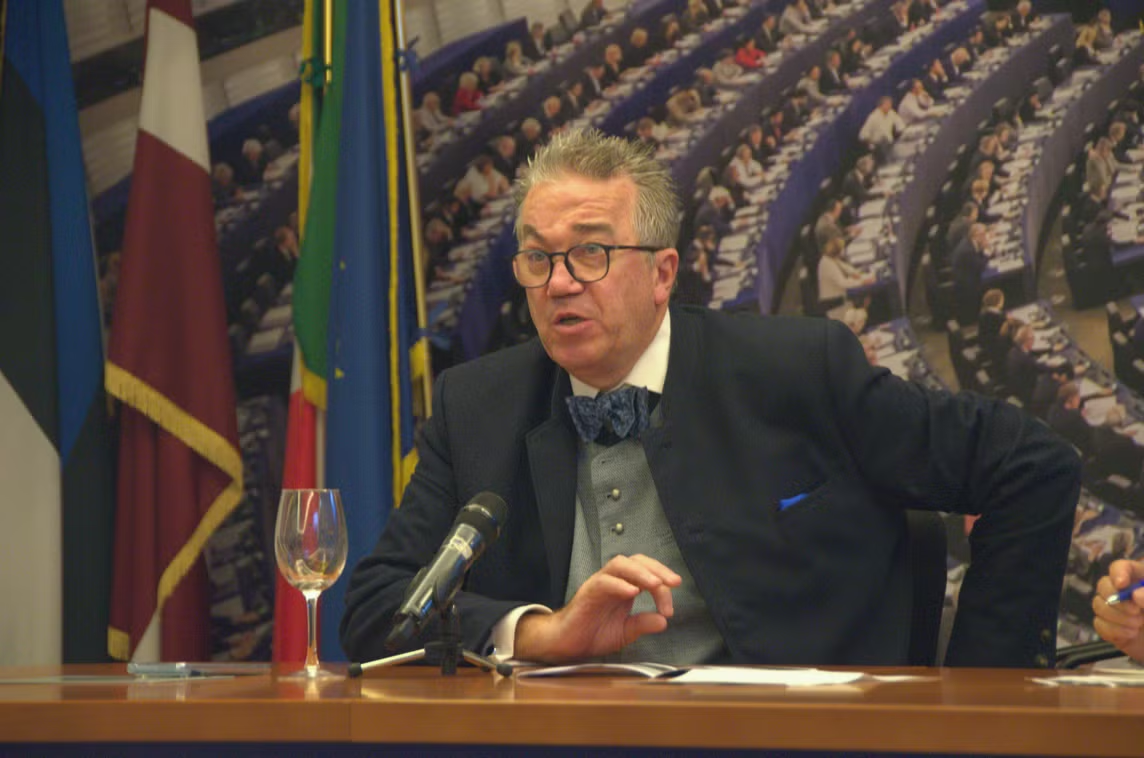
Against a backdrop of ongoing debates on tariffs and protectionist policies, participants highlighted growing concerns around deregulation in e-commerce. Hans Carpels, President of the EuCER Council, pointed to the increasing volume of goods entering Europe from outside the EU as a critical issue:
“Recent developments have shown that the flow of imported goods has become unsustainable. We urgently need EU intervention to restore a level playing field.”
Andrea Scozzoli also underlined the dual nature of e-commerce: while it significantly improves consumer access and convenience, it also introduces risks. In particular, large non-EU companies—often based in Asia—can place vast quantities of products on the European market with limited oversight, sometimes failing to comply with EU standards, including environmental regulations. “These operators often lack legal representation within the EU and can bypass fiscal obligations,” Scozzoli warned, “creating unfair competition for European businesses and potential risks for consumers and the environment.”
The consumer electronics sector, often a forerunner of broader economic trends, is among the most affected by these dynamics. As highlighted by Vittorio Mastromano, the sector is valued at approximately €190 billion at EU level, with the Italian market alone worth €17 billion. It also encompasses a complex value chain, from production and logistics to retail and after-sales services.
Despite the growth of online channels, physical retail continues to play a central role in Italy, accounting for around three-quarters of total sales. However, the COVID-19 pandemic has accelerated digital adoption, even among smaller businesses. “While the scenario is evolving, total deregulation would pose significant risks for both local shops and large-scale distribution,” noted Dario Bossi.
From a policy perspective, Maurizio Gasparri emphasised that fair competition remains a fundamental principle, yet is frequently undermined. He highlighted the importance of coordinated European action, including measures proposed in De Meo’s resolution to strengthen fiscal controls and improve oversight of small parcel shipments, which can be used to circumvent regulations. He also noted that unfair competition extends beyond e-commerce, affecting multiple sectors, and raised concerns about broader implications such as social dumping.
In July, the European Parliament took a first step by adopting a non-binding resolution aimed at improving the management of low-cost goods entering the EU. As rapporteur, Salvatore De Meo called for accelerated reform of customs authorities, clearer accountability in online transactions, and greater harmonisation of rules governing both intra-EU and international trade.
“E-commerce must be recognised as an area requiring stronger regulation,”
he stated, warning that regulatory gaps are being exploited by foreign operators, leading to safety concerns and unfair competition.
Additional contributions from MEP Brando Benifei and MP Antonino Iaria reinforced the need for a fair and consistent regulatory framework applicable to all market players.
Concluding the discussion, Davide Rossi described the De Meo resolution as an important starting point, complementing existing frameworks such as the Digital Services Act. However, he stressed that further action is needed, including regulatory updates, enhanced technical tools for customs authorities, and increased consumer awareness. “Consumers often focus solely on price, assuming all technology products are the same,” Rossi noted. “In reality, this can lead to the purchase of unsafe or low-quality products, often lacking proper guarantees.”


About the EuCER Council
The European Consumer Electronics Retail Council (EuCER) is an association founded by Aires, E-Square, Euronics International, Expert International and Unieuro, established as an International Association without Lucrative Purpose and based in Etterbeek (Brussels), 10 Charles-Maurice Wiser Square.
The EuCER Council represents European Retail Groups and Chains operating in the sale of Technical Consumer Goods, such as Major Domestic Appliances, Healthcare Products, and Audio and Video Devices.
The Council constantly participates to the public debate with the main purpose of promoting a clear and non-discriminatory, legal and regulatory framework for the retail sector of consumer electronics and household appliances in Europe, also focusing on the growth and sustainability of the European economy.
More Info and Contacts
Meridian Communications
Via Cuneo, 3 – 20149 Milano
Phone. +39 02 48519553
Silvia Ceriotti
M.ph. +39 335 7799 816 e-mail: silvia.ceriotti@meridiancommunications.it
Viviana Bandieramonte
M.ph. +39 329 4776 937 e-mail: viviana.bandieramonte@meridiancommunications.it